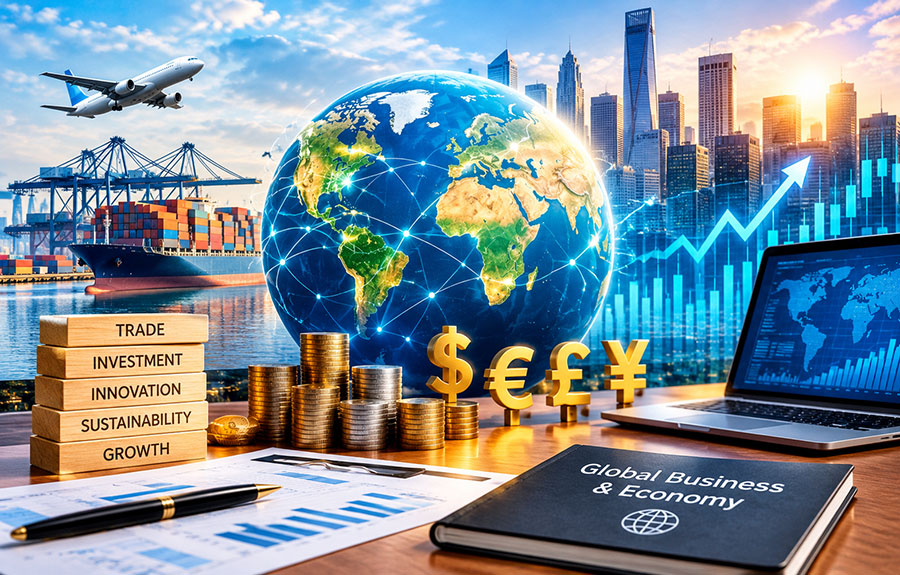
Global Business & Economy: Markets, Trade, Growth & The Future of Business
The global economy is a connected network of businesses, consumers, workers, governments and financial markets. A change in interest rates, a shift in consumer demand, a new trade policy or a disruption in a major supply chain can influence companies far beyond the country where the event begins.
For business owners, professionals and entrepreneurs, understanding these connections is becoming increasingly important. Global business is no longer limited to large multinational corporations. Digital platforms, international payments, remote work and e-commerce have made it possible for smaller businesses to reach customers, suppliers and partners across borders.
1. What Is the Global Economy?
The global economy refers to the combined economic activity of countries and regions around the world. It includes production, trade, services, investment, employment, consumption and financial markets.
Every economy has its own policies and priorities, but countries are closely connected through imports, exports, investment, technology, energy, commodities and financial systems. This connection means that an economic development in one region can create opportunities or challenges somewhere else.
A strong understanding of the global economy helps businesses prepare for change instead of simply reacting to it.
2. Why Global Business Matters
Global business allows companies to access larger customer markets, specialised talent, raw materials, technology and investment. It can also help businesses diversify revenue by serving customers in more than one country.
At the same time, international expansion brings additional responsibilities. Companies may need to understand local regulations, taxes, currencies, cultural expectations, data rules and consumer behaviour before entering a new market.
3. International Trade and Business Growth
International trade remains one of the foundations of the global economy. Countries and companies trade goods, services, technology, agricultural products, energy, machinery and digital solutions based on demand, capability and competitive advantage.
For businesses, trade creates opportunities to find new customers and suppliers. However, tariffs, customs requirements, transport costs, geopolitical developments and changing regulations can influence the final cost of international business.
4. Inflation and the Cost of Doing Business
Inflation affects both consumers and companies. Rising prices for energy, transportation, materials, rent, wages and services can put pressure on business margins. Companies may need to review pricing, purchasing decisions and operating costs when inflation remains elevated.
A practical response is to understand the costs that have the greatest effect on the business. Regular budgeting, cash-flow monitoring, supplier negotiations and sensible pricing decisions can improve resilience during periods of changing costs.
5. Interest Rates and Investment Decisions
Interest rates influence the cost of borrowing and can affect decisions about expansion, equipment purchases, property, hiring and new projects. When financing becomes more expensive, companies may become more selective about investment.
Businesses should consider both short-term borrowing costs and long-term financial commitments. Maintaining a realistic cash-flow forecast can make it easier to evaluate investment opportunities under different economic conditions.
6. Currency Exchange and Global Markets
Exchange rates matter whenever a business earns revenue, purchases products or pays suppliers in another currency. Currency movements can change the value of overseas sales and the cost of imported goods.
Companies with international exposure should identify where currency changes could affect margins. Even small businesses can benefit from tracking exchange rates and including reasonable currency assumptions in budgets and pricing decisions.
7. Global Supply Chains Are Becoming More Strategic
Modern supply chains often cross several countries before a product reaches the customer. This creates efficiency, but it can also create exposure to shipping delays, shortages, natural disasters, policy changes and geopolitical disruptions.
- Identify critical suppliers and materials.
- Understand where important products are sourced.
- Consider alternative suppliers for high-risk items.
- Monitor logistics costs and delivery times.
- Keep practical contingency plans for major disruptions.
8. Technology Is Reshaping the Business Economy
Artificial intelligence, cloud computing, automation, data analytics, digital payments and online platforms are changing how businesses operate. Technology can help companies reduce repetitive work, understand customers, improve productivity and enter new markets.
The best technology strategy is not about adopting every new tool. It is about identifying a real business problem and choosing technology that improves efficiency, customer experience, decision-making or revenue.
9. Artificial Intelligence and the Future of Work
AI is becoming an important part of business planning across industries. It can support research, customer service, content production, data analysis, forecasting and workflow automation.
Businesses should combine technology with human judgement. Clear policies around data privacy, cybersecurity, accuracy and responsible AI use are important as organisations introduce increasingly capable digital tools.
10. Emerging Markets and New Opportunities
Emerging markets can offer growing consumer populations, expanding digital adoption, new manufacturing opportunities and increasing demand for services. They can be attractive to companies looking for long-term growth beyond established markets.
However, entering a new market requires local knowledge. Businesses should research regulations, customer preferences, payment systems, infrastructure, competition and cultural expectations before making major commitments.
11. Consumer Behaviour Is Changing
Consumers now have more information and more choices than ever. Online reviews, comparison tools, social media and digital marketplaces can influence purchasing decisions within minutes.
Successful businesses are responding by focusing on convenience, transparent pricing, reliable service and strong customer experiences. Understanding what customers actually value is often more important than simply following the latest trend.
12. E-Commerce and the Digital Economy
Digital commerce has made it possible for businesses to sell beyond their traditional geographic boundaries. Small companies can use websites, marketplaces, social media and digital payment systems to reach customers in different regions.
Global digital business still requires careful attention to shipping, taxes, payment security, consumer protection, data privacy and local regulations. Growth is strongest when digital expansion is supported by reliable operations.
13. Sustainability and Responsible Business
Sustainability is increasingly becoming part of mainstream business strategy. Companies are examining energy use, waste, resource efficiency, packaging, supply chains and the long-term environmental impact of their operations.
Responsible business does not always require a dramatic transformation. Businesses can begin by measuring important resource use, reducing unnecessary waste, improving efficiency and setting realistic targets that can be tracked over time.
14. Geopolitics and Business Risk
International relations can influence trade, investment, transportation and supply chains. Changes in tariffs, sanctions, alliances, regulations or regional stability can create uncertainty for companies operating across borders.
Businesses cannot control geopolitical events, but they can prepare for different scenarios. Identifying critical markets, suppliers and dependencies can help companies respond more effectively when conditions change.
15. Small Businesses Can Think Globally
Global business is not only for multinational corporations. Freelancers, consultants, manufacturers, educators, software companies, online sellers and specialised service providers can all find international customers.
A sensible approach is to start with one promising market. Test demand, understand customer needs, calculate delivery and payment costs, review legal requirements and improve the offer based on real feedback before expanding further.
16. Jobs, Skills and the Changing Economy
The global economy is changing the skills employers value. Digital literacy, communication, analytical thinking, problem-solving, adaptability and industry-specific knowledge are becoming increasingly important across many professions.
Professionals can strengthen their career position by continuing to learn and by combining technology skills with human abilities such as communication, creativity, leadership and judgement.
17. Global Investment and Business Confidence
Investment decisions are influenced by expected growth, financial conditions, regulations, political stability and business confidence. Investors and companies constantly evaluate where capital may generate sustainable long-term value.
Businesses seeking investment should focus on clear fundamentals: a genuine market need, a practical business model, disciplined financial management and the ability to adapt when market conditions change.
18. The Role of Infrastructure
Transport networks, ports, airports, electricity, telecommunications and digital infrastructure support modern economic activity. Reliable infrastructure can reduce business costs and make it easier for companies to connect with customers and suppliers.
As digital services expand, dependable internet access and secure digital systems are becoming just as important for many businesses as traditional physical infrastructure.
19. What Businesses Should Watch
- Global economic growth and consumer demand.
- Inflation and interest-rate changes.
- Currency and commodity-price movements.
- International trade rules and tariffs.
- Supply-chain reliability and logistics costs.
- AI, automation and digital transformation.
- Cybersecurity and data-protection requirements.
- Geopolitical developments affecting key markets.
- Changing customer expectations.
- Sustainability and resource-efficiency requirements.
20. Building a More Resilient Business
Economic uncertainty is a normal part of doing business. Resilient companies do not attempt to predict every event. Instead, they build systems that allow them to respond when conditions change.
Useful steps include maintaining cash-flow visibility, reviewing major business risks, avoiding unnecessary dependence on one supplier or customer, investing carefully and keeping teams informed about important market developments.
Frequently Asked Questions
What is the global economy?
The global economy is the interconnected system of countries, businesses, workers, consumers and financial markets involved in production, trade, investment and consumption.
Why do global economic trends matter to small businesses?
Global trends can affect customer demand, input prices, borrowing costs, currency values, supply chains and access to international markets.
How can a business prepare for economic uncertainty?
Businesses can monitor cash flow, control unnecessary costs, understand key risks, diversify important suppliers where practical and prepare realistic contingency plans.
How is technology changing global business?
Digital platforms, AI, automation, cloud services and online payments are helping companies improve productivity, serve customers and operate across geographic boundaries.
Can a small business enter international markets?
Yes. Digital tools have made international business more accessible, but companies should research local demand, regulations, taxes, payments, logistics and customer expectations before expanding.
Final Thoughts
The global business and economic environment is constantly changing. Technology, trade, consumer behaviour, financial conditions, geopolitics and sustainability are all influencing the way companies operate and compete.
No business can predict the future perfectly. What it can do is stay informed, understand the factors that matter most to its industry, manage risk responsibly and remain ready to adapt.
For entrepreneurs, professionals and business leaders, understanding the global economy is not about reacting to every headline. It is about seeing the bigger picture and making thoughtful decisions that support sustainable growth.