
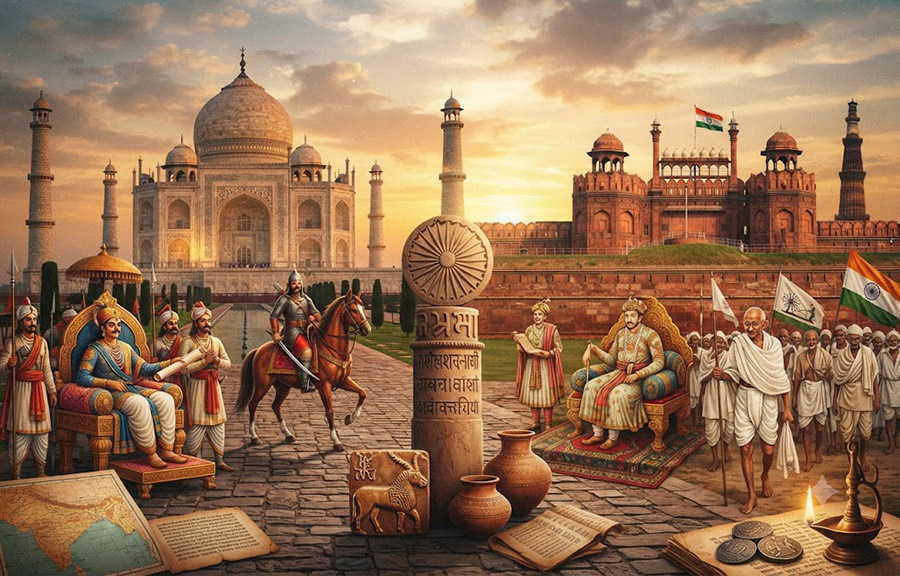
Indian History: From Ancient Civilizations to Modern India
Indian history is a long and diverse story shaped by ancient civilizations, powerful kingdoms, intellectual traditions, trade, cultural exchange, social change and the struggle for independence. From the cities of the Indus Valley to the rise of modern India, each period has contributed to the country’s heritage in different ways.
Understanding Indian history is not only about remembering dates and rulers. It is also about understanding how people lived, how ideas travelled, how languages and cultures developed, and how political and social changes shaped the India we know today.
1. The Indus Valley Civilization
The Indus Valley Civilization, also called the Harappan Civilization, is one of the earliest urban civilizations associated with the Indian subcontinent. Important archaeological sites include Harappa, Mohenjo-daro, Dholavira, Lothal and Rakhigarhi.
Its planned settlements, drainage systems, craft production, trade networks and distinctive artefacts provide evidence of a sophisticated urban society. Much about the civilization continues to be studied because its script has not been conclusively deciphered.
Indian history becomes easier to understand when we see it as a continuous story of people, ideas, institutions and cultures changing over time.
2. The Vedic Period
The Vedic period is associated with the composition and transmission of the Vedas and the development of important religious, social and philosophical traditions. Over time, communities, political structures and economic activities changed across northern parts of the subcontinent.
The later Vedic period saw the growth of larger settlements and political units. Ideas found in later Vedic and philosophical texts became influential in the development of Indian intellectual traditions.
3. Mahajanapadas and the Rise of New Ideas
By the first millennium BCE, several large political territories known as the Mahajanapadas emerged. Among them, Magadha became especially influential and later provided an important base for the rise of the Mauryan Empire.
This period also saw the growth of major intellectual and religious movements, including Buddhism and Jainism. Their teachings contributed significantly to debates about ethics, society, suffering, discipline and the path to liberation.
4. The Mauryan Empire
The Mauryan Empire became one of the most extensive political formations in ancient Indian history. Chandragupta Maurya established the empire, while Ashoka became one of its best-known rulers.
After the Kalinga War, Ashoka is remembered for promoting principles associated with Dhamma, public welfare and ethical conduct. His inscriptions on rocks and pillars are important historical sources for understanding the period.
5. The Gupta Period
The Gupta period is often associated with significant developments in literature, mathematics, astronomy, art and learning. However, historians also emphasise that political power and cultural developments varied across regions and that the period should not be viewed as uniform across the entire subcontinent.
Figures such as Kalidasa are associated with classical Sanskrit literature, while developments in mathematics and astronomy during this broad period influenced later scholarship.
6. South Indian Kingdoms and Maritime Traditions
Indian history was never limited to northern kingdoms. Southern dynasties including the Cholas, Cheras and Pandyas played important roles in politics, trade, temple culture and maritime connections.
The Cholas, in particular, developed a powerful state and maintained maritime links across the Indian Ocean. Temples also became important centres of religious, artistic, economic and social activity in many regions.
7. The Delhi Sultanate
The Delhi Sultanate refers to a series of dynasties that ruled significant parts of northern India between the 13th and early 16th centuries. The period included the Mamluk, Khalji, Tughlaq, Sayyid and Lodi dynasties.
It was a period of political expansion, conflict, administration, trade and cultural interaction. Persian became an important language of administration and culture, while Indian and Central Asian traditions interacted in architecture, literature and everyday life.
8. The Mughal Empire
The Mughal Empire was established by Babur in the early 16th century. Rulers including Akbar, Jahangir, Shah Jahan and Aurangzeb presided over different phases of imperial expansion and administration.
Akbar is known for administrative reforms and policies that included engagement with different religious and intellectual traditions. Mughal architecture, painting, literature and court culture left a lasting mark on the Indian subcontinent.
9. Regional Powers in Medieval India
Medieval Indian history included many powerful regional states alongside the Delhi Sultanate and Mughal Empire. The Marathas, Rajputs, Ahoms, Vijayanagara rulers, Sikhs and several other regional powers played important roles at different times.
The Vijayanagara Empire, for example, became a major centre of political and cultural life in southern India. Hampi remains an important archaeological and heritage site associated with its history.
10. The Rise of European Trading Companies
European maritime powers established trading centres in India from the late 15th century onward. The Portuguese were followed by the Dutch, English and French, each seeking commercial influence.
The English East India Company gradually expanded beyond trade and became a major political power, particularly after military victories and the acquisition of revenue-collecting rights in parts of India.
11. British Rule in India
British control expanded across large parts of the subcontinent during the 18th and 19th centuries. Economic policies, administrative changes, new legal institutions, railways, communications and education systems had complex and often unequal effects on Indian society.
The colonial period also saw economic exploitation, social reform movements, political organisations and growing demands for greater Indian participation in governance.
12. The Revolt of 1857
The uprising of 1857 began among sections of the Bengal Army and spread to several regions. It involved soldiers, rulers, landlords, peasants and other groups with different local concerns and motivations.
The rebellion was eventually suppressed. Afterward, the British Crown assumed direct rule from the East India Company, beginning a new phase commonly known as the British Raj.
13. The Indian National Movement
The Indian National Congress was founded in 1885, and over the following decades the freedom movement developed through many organisations, leaders and forms of political action.
Moderate constitutional politics, revolutionary activities, mass movements, labour and peasant participation, social reform and other approaches all formed part of the wider struggle against colonial rule.
14. Mahatma Gandhi and Mass Movements
Mahatma Gandhi became a major figure in the Indian freedom movement and promoted forms of non-violent resistance and civil disobedience. Major movements associated with him included the Non-Cooperation Movement, Civil Disobedience Movement and Quit India Movement.
Gandhi was not the only important figure in the independence struggle. Leaders and activists such as Jawaharlal Nehru, Sardar Vallabhbhai Patel, Subhas Chandra Bose, Bhagat Singh, Sarojini Naidu, B. R. Ambedkar and many others contributed in different ways to India’s political and social transformation.
15. The Role of Dr. B. R. Ambedkar
Dr. B. R. Ambedkar was a major social reformer, jurist and political thinker who campaigned against caste-based discrimination and worked for social equality and the rights of marginalised communities.
As chairman of the Drafting Committee of the Constituent Assembly, Ambedkar played a central role in the drafting process of the Constitution of India. His contribution remains an important part of India’s constitutional history.
16. Independence and Partition in 1947
India became independent from British rule on 15 August 1947. Independence was accompanied by the Partition of British India, which led to the creation of India and Pakistan and caused one of the largest population movements in modern history.
Partition brought immense displacement, violence and loss of life. Its human consequences continue to be remembered through family histories, literature, memorials and historical research.
17. The Constitution of India
The Constitution of India was adopted by the Constituent Assembly on 26 November 1949 and came into force on 26 January 1950. India became a republic, with a constitutional framework defining institutions, rights, responsibilities and the structure of government.
The Constitution is central to understanding modern India because it establishes the legal and institutional foundation of the country’s democratic system.
18. India After Independence
Independent India faced major challenges including refugee rehabilitation, economic development, food security, institution building and the integration of princely states. The country gradually developed a large democratic and administrative system.
India also underwent major changes in agriculture, industry, education, science and technology. The Green Revolution, economic reforms of 1991 and the growth of information technology were among important developments in the post-independence period.
19. Indian Heritage, Art and Architecture
India’s history can be seen in its monuments, temples, mosques, churches, gurdwaras, forts, caves, stupas, palaces, paintings and archaeological sites. These structures reflect different periods, regions, materials and artistic traditions.
Heritage sites such as the Taj Mahal, Ajanta and Ellora Caves, Sanchi, Hampi, Qutub Minar and numerous regional monuments help connect the present with different chapters of the past.
20. Why Indian History Matters Today
Studying history helps us understand how present-day institutions, communities, languages, borders, traditions and social ideas developed. It also teaches us that historical events can have different effects on different groups.
A balanced study of Indian history should use archaeological evidence, inscriptions, literary sources, official records, oral histories and modern historical research while recognising that some events and interpretations remain subjects of scholarly debate.
Frequently Asked Questions
What are the main periods of Indian history?
Indian history is commonly studied through broad phases such as ancient, medieval and modern periods, although historians use more detailed and overlapping timelines within these categories.
Which is one of the earliest major civilizations in Indian history?
The Indus Valley or Harappan Civilization is one of the earliest major urban civilizations associated with the Indian subcontinent.
Who established the Mauryan Empire?
Chandragupta Maurya established the Mauryan Empire in the late 4th century BCE.
When did India become independent?
India became independent from British rule on 15 August 1947.
When did the Constitution of India come into force?
The Constitution came into force on 26 January 1950, celebrated as Republic Day.
Why should Indian history be studied from multiple sources?
Different sources provide different kinds of evidence. Comparing archaeology, inscriptions, texts, records and historical scholarship can provide a more complete understanding of the past.
Final Thoughts
Indian history is a vast journey spanning thousands of years, countless communities and many forms of political, cultural and intellectual change. No single article can cover every region, dynasty, movement or historical debate, but understanding the broad timeline provides a useful foundation.
Learning history with curiosity and attention to evidence helps us appreciate India’s heritage while also understanding the challenges and changes that shaped modern India.