
Government Jobs in India: Where to Find Vacancies and How to Prepare
Getting a government job is a goal for many students and working professionals in India because public-sector roles can offer structured career paths, defined recruitment rules and opportunities to serve the community. The process can feel confusing, especially when vacancies appear across different departments and portals. This guide from News i1 explains how to find genuine government job notifications, check eligibility, build a realistic preparation plan and track your application without relying on rumours or paid “guaranteed selection” promises.
Important: Recruitment dates, vacancies, eligibility and exam patterns change. Always confirm every detail in the official notification before applying. News i1 is an information guide, not a government recruitment agency, and cannot guarantee a job or selection.
Where to Find Genuine Government Job Vacancies
Start with the organisation that is actually recruiting. Search for the official website of the commission, department, public-sector organisation or state recruitment board, then open its recruitment, careers, notifications or advertisements section. Use the following trusted starting points:
- UPSC: upsc.gov.in — examination calendar, recruitment advertisements, syllabi, previous question papers, results and marks information.
- Staff Selection Commission (SSC): ssc.gov.in — central recruitment examinations such as CGL, CHSL, MTS, Selection Posts and other notified examinations.
- Railway Recruitment: start from the official Indian Railways website at indianrailways.gov.in and follow links to the relevant Railway Recruitment Board (RRB). Check that the RRB website and notification are genuine before submitting details.
- National Career Service (NCS): ncs.gov.in — government employment services and career-related information. Check the details of each listing and its recruiting organisation.
- State government jobs: visit your state Public Service Commission, subordinate services selection board, police recruitment board, education department or official state employment portal.
- Defence, banking and public-sector organisations: use the relevant official recruitment site, such as the organisation’s own careers page or the authorised examination body named in the notification.
For every vacancy, save the official notification PDF. It is the primary reference for post names, number of vacancies, age limits, educational qualifications, category relaxations, fee, selection stages, documents and deadlines.
How to Check Whether a Government Job Notification Is Real
- Check the website address carefully and navigate to the recruitment page from the organisation’s official homepage.
- Match the advertisement number, post name, dates and application link against the official notice.
- Read the full notification, including corrigenda or updates published later.
- Pay application fees only through the payment method stated on the official application portal.
- Keep the application number, payment receipt, submitted form and confirmation email or PDF.
Scam warning: Avoid anyone promising guaranteed selection, leaked papers, a backdoor appointment or a job in exchange for money. Do not share OTPs, passwords or banking PINs. A coaching centre or social media channel may help you discover a notice, but the official recruiting body must remain your final source of truth.
Which Government Job Is Suitable for You?
Choose an examination based on your qualification, age, skills, interests and willingness to relocate—not only on the popularity of a job. Eligibility varies by post and notification.
- After Class 10: some MTS, constable, trades, apprentice or support roles may be available, depending on the specific notice and required qualifications.
- After Class 12: consider eligible SSC CHSL posts, selected police or defence entries, clerical roles and state-level recruitment.
- After graduation: explore UPSC Civil Services, SSC CGL, State PSC examinations, banking recruitment, graduate-level railway posts and specialist roles that match your degree.
- Technical or professional qualifications: look for engineering, medical, teaching, law, accounting, IT, research and other specialist vacancies that state the required degree, licence or experience.
These are examples, not a promise of current vacancies. Confirm each post’s exact age range, qualification, subject requirements, physical standards and other conditions in the latest advertisement.
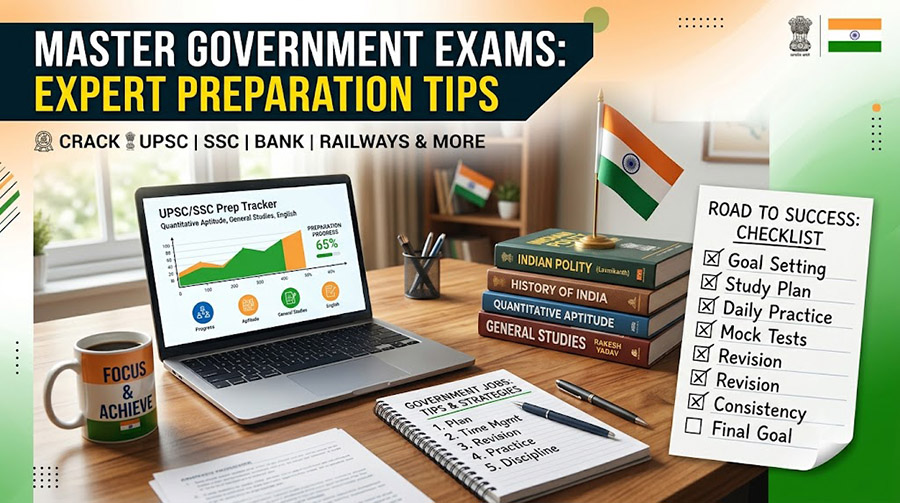
Government Exam Preparation: A Practical Study Plan
- Read the syllabus first: download the official syllabus and exam scheme. Identify subjects, question types, negative marking, stages and qualifying requirements.
- Take a diagnostic test: attempt a previous paper under timed conditions. Use the result to identify your strongest and weakest areas.
- Build a realistic timetable: divide study time between concepts, practice questions, revision and mock tests. A consistent plan that fits your daily responsibilities is more useful than an unrealistic schedule.
- Use previous-year papers: practise authentic papers available from the recruiting body or reliable publishers. Review every mistake and note recurring topics without assuming that past questions will be repeated.
- Practise timed tests: improve accuracy and speed gradually. Review incorrect answers and questions that took too long, not just your final score.
- Revise actively: use short notes, flashcards, formula sheets and weekly review sessions. Revisit difficult topics at planned intervals.
- Prepare for every stage: depending on the recruitment, this may include a written exam, skill test, physical test, interview, document verification or medical examination.
- Protect your routine: sleep adequately, take breaks and avoid comparing your progress with every aspirant on social media.
Sample Weekly Study Routine
Adjust this example to the exam you are targeting and the time you can realistically give each day.
- Monday to Thursday: study two core topics, solve practice questions and revise yesterday’s notes.
- Friday: focus on current affairs or general awareness where relevant, plus a short sectional test.
- Saturday: attempt a timed mock test or previous-year paper and analyse errors.
- Sunday: revise weak topics, update your error notebook and plan the next week. Include rest time to avoid burnout.
If you are working or studying full-time, shorter daily sessions may be more sustainable. Measure progress by the topics mastered and mistakes corrected, not only by hours spent at a desk.
Authentic Recruitment and Success-Report Details: What the Numbers Mean
It is important to distinguish official recruitment statistics from personal success stories shared online. For a verified example of the scale of competitive recruitment, the Government of India’s Department of Personnel and Training (DoPT) Annual Report 2024–25 reports that during 2023–24 the UPSC conducted 22 examinations under recruitment by examination and processed 25,70,244 applications. The report’s table records 7,999 candidates recommended in total across the civil services/posts and defence services categories shown in that table. These figures refer to the specific UPSC activities and reporting period described in the report; they are not statistics for every government recruitment in India.
What can an aspirant learn from official reports? Competition can be substantial, so verify eligibility before applying, prepare against the actual syllabus, practise under exam conditions and use official result notices to understand the selection stages. The number of applications is not the same as the number of candidates who sit the exam, and a recommendation figure is not the same as a universal selection rate for all applicants.
For current and exam-specific outcomes, consult the recruiting body’s own results and annual reports. For example, the UPSC website publishes results, marks and recruitment information, while the SSC website publishes examination notices and results. Always note the examination year and the exact stage covered by a result.
Learning from Successful Candidates Without Falling for Fake Claims
There is no single routine that works for every selected candidate. When reading an interview or success story, look for details that can be checked: the examination name and year, the candidate’s preparation approach, the official result or rank where publicly available, and a clear distinction between personal experience and general advice.
- Use a candidate’s routine as an idea, not as a rule you must copy exactly.
- Be cautious of dramatic claims such as “selection in seven days” or “100% guaranteed government job.”
- Do not treat paid testimonials, screenshots or coaching advertisements as official proof of selection.
- Remember that a result depends on the exam, vacancies, eligibility, performance and the applicable recruitment rules—not on one book or course alone.
Editorial note: This article does not invent named candidate testimonials or claim that News i1 has independently verified individual success stories. Official recruitment statistics and result links are provided so readers can check the source themselves.
Application Checklist: Before You Submit
- Confirm the post, department, advertisement number and closing date.
- Check age and educational eligibility on the relevant cut-off date.
- Review category, domicile, experience, language, physical or professional requirements where applicable.
- Prepare accurate personal details and the documents specified in the notice.
- Upload a recent photograph, signature and certificates in the required format and size.
- Review the form carefully before final submission; corrections may not always be permitted.
- Save the final application, registration number, fee receipt and important dates.
- Check the official portal for admit cards, exam-city notices, answer keys, objections, results and document-verification instructions.
How News i1 Can Help You Find Government Jobs
Use News i1 as a discovery and learning resource: look for our career and education articles for preparation guidance, application checklists, exam explanations and reminders about checking official notifications. When reviewing a job update on our website, follow the official-source link provided and read the original advertisement before taking action. If a particular vacancy is not linked to an official notice, do not assume it is verified or current.
For a useful job-search habit, create a small tracker with the recruiting organisation, post name, official notification URL, eligibility, application deadline, exam date, status and next action. Review it once or twice each week. This makes it easier to manage multiple applications and reduces the chance of missing a deadline.
Frequently Asked Questions About Government Jobs
Which website is best for finding government jobs in India?
There is no single site covering every recruitment. Start with the official UPSC, SSC, relevant state commission, Railway Recruitment Board or department website. NCS can also be a useful career-information starting point.
Can I get a government job after Class 10 or Class 12?
Some recruitments accept Class 10 or Class 12 qualifications, but eligibility depends on the specific post, age limits, subject requirements and other conditions stated in the official notification.
How many hours should I study each day?
There is no universal number. Build a consistent schedule around your exam date, current preparation level and responsibilities. Focus on syllabus coverage, question practice, revision and analysis of mock tests.
Are government jobs listed on social media genuine?
Some posts may share real notices, but social media is not sufficient proof. Verify the advertisement and application link on the recruiting organisation’s official website before sharing documents or paying a fee.
Can anyone guarantee government job selection?
No legitimate coach, website or agent can guarantee selection. Recruitment follows the official process, eligibility rules, examination performance and available vacancies. Avoid anyone asking for money in exchange for guaranteed appointment.
Where can I check authentic exam results and selection information?
Use the recruiting authority’s official results page and read the notice carefully. Check the examination year, stage, roll-number or name list, marks notice and any further instructions.
Final Words: Plan Carefully, Prepare Consistently
A government job search becomes more manageable when you use official sources, target examinations that match your qualifications and follow a preparation routine you can maintain. Read notifications in full, track deadlines, practise with previous papers and learn from genuine result information rather than viral claims. A careful, steady approach will not guarantee selection, but it can help you make better decisions and prepare with greater confidence.