
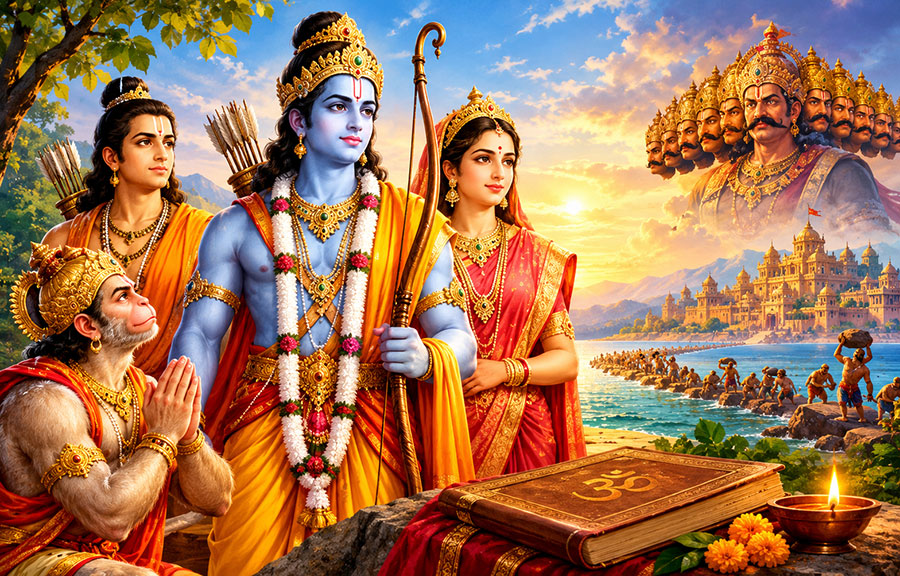
Ramayan: Story, Teachings, Characters & Timeless Values
The Ramayan is one of India’s most enduring epics, a story of duty, courage, devotion, family, sacrifice and the struggle between righteousness and wrongdoing. Its central figure, Lord Ram, is remembered as Maryada Purushottam—a symbol of ideal conduct, responsibility and compassion. Across generations, the Ramayan has shaped Indian literature, culture, festivals, art, theatre and spiritual life.
More than a traditional epic, the Ramayan continues to offer practical reflections on relationships, leadership, self-discipline, difficult decisions and the importance of keeping one’s values intact. Different regional traditions and retellings present the story in their own distinctive ways, while the core themes of dharma, devotion and moral courage remain deeply relevant.
What Is the Ramayan?
The Ramayan is traditionally attributed to Maharishi Valmiki and is regarded as one of the great Sanskrit epics of India. It narrates the life journey of Lord Ram, his marriage to Sita, his exile from Ayodhya, the abduction of Sita by Ravana, the search for her with the help of devoted allies, and the eventual victory of righteousness over arrogance and injustice.
The story has been retold in many languages and literary traditions. Among the best-known devotional retellings is Goswami Tulsidas’s Ramcharitmanas, which played a major role in bringing the story of Ram to a wider Hindi-speaking audience.
The Birth and Early Life of Lord Ram
Lord Ram is described as the son of King Dasharath and Queen Kaushalya of Ayodhya. His childhood is presented as a period of learning, discipline and preparation for responsibility. Along with his brothers Bharat, Lakshman and Shatrughna, Ram grows up in a royal environment while remaining grounded in respect for elders, teachers and duty.
His early life also introduces the values that become central to the epic: humility despite strength, obedience without weakness, and courage guided by wisdom.
Ram and Sita: A Story of Commitment
The relationship between Ram and Sita is an important part of the Ramayan. Their marriage represents companionship, mutual respect and commitment through difficult circumstances. When Ram is sent into exile, Sita chooses to accompany him, demonstrating her determination and devotion.
Their journey also reminds readers that relationships are tested not only during comfortable times but during uncertainty, separation and hardship. Their story has remained an important part of Indian cultural and devotional traditions.
The Exile of Lord Ram
One of the defining moments of the Ramayan occurs when Ram accepts fourteen years of exile because of a promise made by his father, King Dasharath. Although the decision changes the future of Ayodhya, Ram chooses to honour his father’s word rather than pursue his own immediate interests.
Lakshman and Sita accompany him into the forest. Their exile becomes a major turning point in the epic, introducing new characters, challenges and moral choices.
Lakshman and the Value of Loyalty
Lakshman is remembered for his unwavering loyalty to Ram and Sita. He leaves the comforts of Ayodhya to share their life in the forest and remains a courageous companion throughout the journey.
His character highlights the importance of standing beside loved ones during difficult times. At the same time, the Ramayan shows that loyalty is most meaningful when it is combined with discipline, responsibility and respect for the larger purpose.
Sita in the Ramayan
Sita is one of the central figures of the epic. She is portrayed through qualities such as courage, determination, dignity and resilience. Her life changes dramatically after Ravana takes her to Lanka, yet she remains firm in her convictions.
Her story has inspired generations of readers, artists and storytellers. Modern readers also engage with Sita’s character through different interpretations, making her one of the most discussed and influential figures in Indian epic literature.
Ravana and the Lesson of Arrogance
Ravana, the powerful king of Lanka, is a complex character in the Ramayan. He is associated with knowledge, power and great abilities, but his pride, desire and misuse of power ultimately lead to his downfall.
His story carries a lasting lesson: intelligence and strength cannot protect a person from the consequences of arrogance and unethical choices. Power becomes destructive when it is separated from self-control and righteousness.
Hanuman: The Symbol of Devotion and Courage
Hanuman is among the most beloved figures in the Ramayan. His devotion to Lord Ram, extraordinary courage, humility and willingness to serve have made him an enduring symbol of bhakti and strength.
Hanuman’s journey—from meeting Ram to crossing the ocean, finding Sita in Lanka and supporting the mission against Ravana—shows how faith combined with action can overcome seemingly impossible obstacles.
The Role of Dharma in the Ramayan
Dharma is one of the central ideas running through the Ramayan. It can be understood broadly as righteous conduct, duty, responsibility and living according to ethical principles. The characters repeatedly face situations where personal wishes conflict with responsibilities.
The epic does not reduce every decision to an easy answer. Instead, it encourages reflection on consequences, relationships, promises and the responsibilities that come with power or position.
Ayodhya and the Return of Ram
Ayodhya is closely connected with the story of Ram and remains an important spiritual and cultural symbol. After the period of exile and the defeat of Ravana, Ram’s return to Ayodhya is celebrated as a moment of hope, renewal and the triumph of righteousness.
The traditional celebration of Diwali is strongly associated with the return of Ram to Ayodhya in many Indian cultural traditions. The lighting of lamps represents the victory of light over darkness and good over evil.
Ramayan and Indian Culture
The influence of the Ramayan extends far beyond literature. Its stories appear in folk performances, classical and regional theatre, television, dance, painting, sculpture, music and festivals across India and in several parts of Asia.
Ramlila performances, especially during the festive season, bring episodes from the epic to local communities. These living traditions demonstrate how the Ramayan continues to connect generations through storytelling and shared cultural memory.
Important Teachings of the Ramayan
Duty matters: The story repeatedly highlights the importance of accepting responsibility and fulfilling commitments.
Character is greater than power: Strength becomes meaningful when guided by discipline and ethical values.
Devotion inspires action: Hanuman’s service shows that devotion can be expressed through courage, effort and selflessness.
Arrogance has consequences: Ravana’s downfall demonstrates the dangers of allowing pride and desire to control decisions.
Family relationships require sacrifice: The epic presents difficult choices involving parents, spouses, brothers and responsibilities.
Leadership requires restraint: Ram’s story is often remembered for placing duty and the welfare of others above personal comfort.
Ramayan and Modern Life
The Ramayan remains relevant because its central questions are still familiar. People continue to face choices involving career, family, promises, leadership, relationships, ambition and personal ethics.
Its teachings can encourage patience before making decisions, respect for family, responsible use of authority, compassion toward others and the courage to remain principled when circumstances become difficult. Readers can approach the epic as a spiritual text, a literary masterpiece, a cultural tradition or a source of ethical reflection.
Why the Ramayan Is Still Relevant Today
In a rapidly changing world, the Ramayan continues to attract readers because its themes are deeply human. It explores love, separation, ambition, loyalty, leadership, temptation, grief, courage and hope—experiences that remain part of everyday life.
Its continued popularity also comes from the many ways people interpret and retell it. Families, teachers, scholars, artists and spiritual communities continue to discover new perspectives within its characters and episodes.
Frequently Asked Questions
Who wrote the Ramayan?
The Sanskrit Ramayan is traditionally attributed to Maharishi Valmiki. Many later poets and authors created influential regional and devotional retellings.
Who is the main character of the Ramayan?
Lord Ram is the central figure of the epic, with Sita, Lakshman, Hanuman, Ravana and many other characters playing important roles.
What is the main message of the Ramayan?
Among its major themes are dharma, duty, devotion, courage, self-control, family responsibility and the victory of righteousness over wrongdoing.
Why is Hanuman important in the Ramayan?
Hanuman represents devotion, courage, humility, service and determination. His actions play a crucial role in helping Ram find Sita and confront Ravana.
What does Ravana represent?
Ravana is often understood as a symbol of great ability combined with destructive pride, desire and misuse of power. His story emphasizes the consequences of arrogance and unethical choices.
How is the Ramayan connected with Diwali?
In a widely followed Indian tradition, Diwali commemorates the return of Ram to Ayodhya after his exile and victory over Ravana, symbolizing the triumph of light over darkness.
Final Thoughts
The Ramayan is more than an ancient story. It is a vast cultural and spiritual tradition that has influenced Indian thought, literature, art, festivals and everyday values for centuries. Its characters continue to inspire discussion because they represent courage, devotion, responsibility, ambition, loyalty and the consequences of moral choices.
Whether read as an epic, a devotional tradition or a guide for reflection, the Ramayan invites us to think about the kind of person we want to become. Its enduring message is that true strength is not simply the ability to win—it is the ability to remain principled, compassionate and responsible when life becomes difficult.