
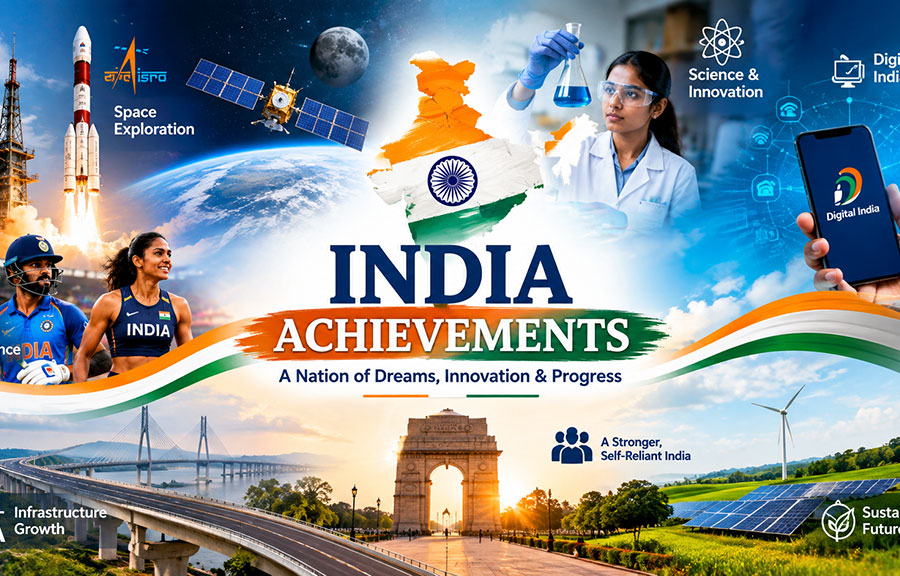
India Achievements: Milestones That Shaped a Nation
India’s story is filled with moments when curiosity, persistence and collective effort turned ambitious ideas into real progress. From reaching the Moon’s surface to building digital services used by millions, the country’s achievements are not limited to one field or one generation. They are shaped by scientists, athletes, entrepreneurs, workers, teachers and ordinary citizens whose contributions often happen far from the spotlight.
Here is a closer look at some milestones that help explain how India has been building capability, solving problems and expanding its presence on the world stage.
1. Chandrayaan-3: A Historic Lunar Landing
In August 2023, India’s Chandrayaan-3 mission achieved a successful soft landing near the Moon’s south polar region. India became the first country to land successfully in that region and the fourth to achieve a soft landing on the Moon. The mission’s Vikram lander and Pragyan rover carried out experiments and observations, adding to scientific understanding of the lunar environment.
Beyond the headline, the mission reflected years of engineering, testing and teamwork by the Indian Space Research Organisation (ISRO) and its partners. It also gave students and young researchers a vivid example of what patient scientific work can accomplish.
“Big milestones are built from thousands of careful steps—often taken by people whose names never make the headlines.”
2. India’s Growing Space Programme
India’s space journey includes the Mars Orbiter Mission, which entered Mars orbit in 2014 on its first attempt, and a series of launch vehicles and satellite missions that support communication, weather forecasting, navigation and Earth observation. These programmes serve practical needs at home while strengthening India’s scientific and engineering experience.
ISRO’s work also demonstrates a distinctive focus on developing reliable capabilities under demanding technical and budget conditions. Upcoming missions will continue to test the country’s ability to design, launch and operate increasingly complex systems.
3. UPI and the Expansion of Digital Payments
The Unified Payments Interface (UPI) has changed how many people in India transfer money. With a mobile app and a linked bank account, users can make payments between individuals and merchants in seconds. Small shops, street vendors and service providers can accept digital payments without relying only on cash or expensive card infrastructure.
UPI’s growth is part of a wider digital public infrastructure story involving bank accounts, identity services and online access to public and private services. Access and connectivity are not equal everywhere, but these tools have made everyday transactions more convenient for a large number of people.
4. Scientific Innovation and Public Health
Indian researchers and manufacturers have built substantial capacity in pharmaceuticals, vaccines and public-health technology. During the COVID-19 pandemic, India’s vaccine production and vaccination programme played a major role in domestic immunisation, while vaccine supplies were also shared with other countries through different channels.
India’s broader scientific community works across agriculture, biotechnology, medicine, materials and climate research. The impact of this work is often measured not only in publications or awards, but also in more accessible treatments, stronger food systems and practical solutions for communities.
5. Sporting Moments That Inspired Millions
Indian athletes have created memorable moments across disciplines. Neeraj Chopra’s Olympic gold in men’s javelin at Tokyo 2020 marked India’s first Olympic gold in athletics. The Indian men’s hockey team won Olympic bronze medals at Tokyo 2020 and Paris 2024, renewing attention to a sport with a deep history in the country.
India’s achievements in chess, badminton, wrestling, boxing, shooting and para-sports have also widened the picture of sporting excellence. Behind every medal are years of training, coaching, family support and access to facilities—reminders that sustained investment in grassroots sport matters.
6. Infrastructure Connecting a Vast Country
India continues to expand and modernise its transport networks, including highways, railways, metro systems, airports and freight corridors. These projects can shorten journeys, improve access to jobs and services, and help businesses move goods more efficiently. New infrastructure also brings responsibilities: safe design, reliable maintenance, fair rehabilitation and attention to environmental impact.
For many residents, progress is experienced in very ordinary ways—a more dependable commute, a safer crossing, or a quicker trip to a hospital or college. Those everyday improvements are an important part of the national development story.
7. Renewable Energy and the Clean-Energy Transition
India has made major investments in solar and wind power and has set ambitious goals for expanding non-fossil energy capacity. Large solar parks, rooftop installations and new transmission projects are helping bring renewable electricity into the energy mix. The country’s International Solar Alliance initiative has also encouraged cooperation on solar energy among participating nations.
The transition is a long-term effort rather than a finished achievement. Storage, grid upgrades, affordability and dependable power supply remain important challenges as India works to meet rising energy demand while reducing pollution and emissions.
8. Entrepreneurship, Manufacturing and Innovation
India’s start-up ecosystem has grown across software, financial technology, logistics, health services, education and manufacturing. Entrepreneurs are building products for local needs, while established industries continue to develop skills and supply chains in areas such as electronics and automotive technology.
Not every new venture succeeds, and innovation takes more than a good idea. Access to finance, skilled workers, research partnerships and clear rules all influence whether promising work can grow into lasting jobs and useful services.
What These Achievements Have in Common
India’s milestones are diverse, but many share a few foundations: investment in education and research, collaboration across institutions, practical problem-solving and the determination to keep improving after setbacks. They also remind us that national progress is not only about spectacular firsts. It includes stronger public services, opportunity for young people and solutions that make daily life better.
How Citizens Can Be Part of India’s Progress
- Build useful skills and stay curious about science, technology and the world around you.
- Support local innovation and responsible businesses where possible.
- Encourage girls and boys equally to explore sports, research and technical careers.
- Use public resources responsibly and participate constructively in your community.
- Celebrate achievements while asking thoughtful questions about inclusion, safety and long-term impact.
Final Thoughts
India’s achievements are not a single story of success, but a collection of journeys—some celebrated globally, others quietly improving lives. From lunar exploration and digital payments to sporting excellence and clean-energy development, these milestones show what sustained effort can make possible.
The next chapter will be written by people learning, building, questioning and working together. Recognising past progress is meaningful; turning that inspiration into broader opportunity is the work that lies ahead.