
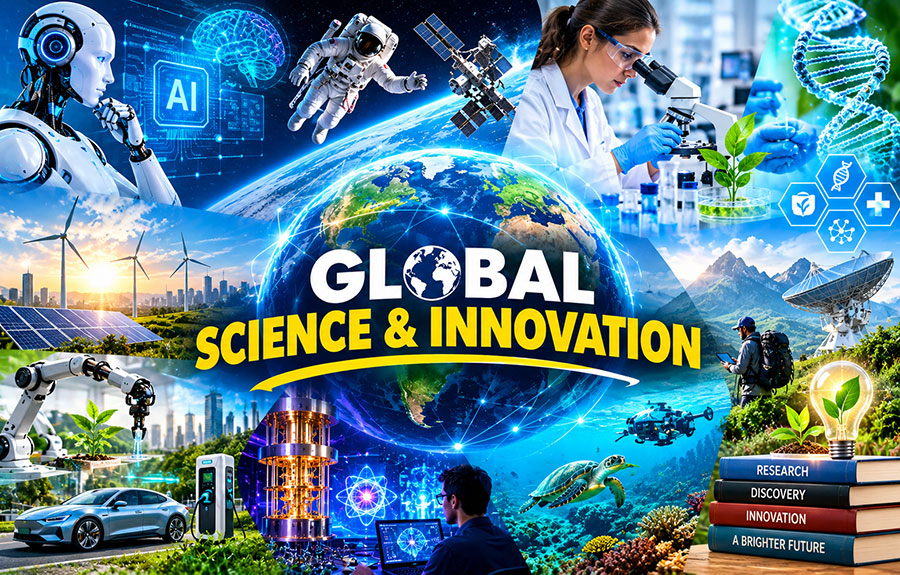
Global Science & Innovation: Discovery, Technology, Research & The Future
Science and innovation shape the way humanity understands the world, solves difficult problems and builds the technologies of tomorrow. From artificial intelligence and space exploration to biotechnology, clean energy, quantum computing and advanced materials, scientific progress is influencing everyday life as well as the future of global economies.
Global science is not limited to laboratories or universities. Research can lead to better medicines, safer infrastructure, cleaner energy, smarter agriculture, faster communication and new industries. Understanding major scientific and innovation trends helps students, professionals, businesses and everyday readers make sense of a rapidly changing world.
1. What Is Global Science and Innovation?
Global science and innovation covers scientific research, technological development and practical discoveries that create knowledge or solve problems across countries and communities. It includes fields such as physics, chemistry, biology, astronomy, medicine, engineering, computer science, environmental science and materials research.
Modern research is increasingly international. Scientists, universities, companies and public institutions often share knowledge, equipment, data and expertise across borders, helping important discoveries move from research environments toward real-world applications.
Scientific progress begins with curiosity, but meaningful innovation turns knowledge into solutions that can improve lives.
2. Why Science Matters in Today's World
Science helps society understand natural processes, assess evidence and develop solutions to complex challenges. It supports fields ranging from healthcare and agriculture to transportation, communication, energy and environmental protection.
Innovation adds another important step by turning ideas and discoveries into useful products, services, systems and processes. Strong scientific foundations therefore play an important role in long-term economic and social development.
3. Artificial Intelligence and Intelligent Systems
Artificial intelligence is one of the most significant areas of modern technological innovation. AI systems can process large amounts of information, recognise patterns, generate content, support research and automate selected tasks.
Scientific and industrial applications of AI include drug discovery, climate modelling, medical imaging, engineering design, language technologies and data analysis. Responsible development remains important because AI systems require attention to accuracy, privacy, security, transparency and human oversight.
4. Generative AI and Scientific Research
Generative AI can assist researchers and professionals with tasks such as summarising information, exploring ideas, analysing documents, writing code and working with complex datasets. It can help reduce time spent on repetitive information-processing tasks.
AI-generated results still need expert review. Scientific work depends on reliable evidence, reproducible methods and careful interpretation, so researchers must verify outputs rather than treating AI responses as automatically correct.
5. Space Exploration and Astronomy
Space science continues to expand our understanding of planets, stars, galaxies and the origins of the universe. Space missions also produce practical benefits through satellite communication, Earth observation, navigation, weather monitoring and scientific data.
New launch technologies, advanced spacecraft, robotic missions and increasingly capable telescopes are opening additional opportunities for exploration. Space research also encourages progress in materials, electronics, computing and engineering.
6. Biotechnology and the Life Sciences
Biotechnology applies biological knowledge and techniques to areas such as medicine, agriculture, food production and industrial processes. Advances in genetics, cell biology and molecular science are helping researchers investigate diseases and develop new approaches to treatment.
Biotechnology can also support improved crops, biological manufacturing and environmental applications. Because these technologies can affect health, ecosystems and society, responsible research, safety assessment and appropriate regulation are essential.
7. Genetics and Gene Editing
Genetic research has transformed scientists' understanding of how biological information is stored and expressed. Modern tools for studying and modifying genetic material have created new possibilities for research and potential medical applications.
Gene editing also raises complex ethical and safety questions. Decisions involving human genetics, inherited changes, clinical applications and biological risk require careful scientific evidence, oversight and public discussion.
8. Quantum Computing and Quantum Science
Quantum science explores physical behaviours that differ from the rules used in ordinary computing and classical systems. Quantum computing uses these principles to investigate new approaches to certain computational problems.
The technology is still developing, but research into quantum processors, sensors, communications and algorithms could influence fields such as materials science, chemistry, optimisation and secure communications. Significant engineering challenges remain before many large-scale applications become practical.
9. Robotics and Autonomous Systems
Robotics combines mechanical engineering, sensors, software and intelligent control to create machines that can perform physical tasks. Robots are used in manufacturing, logistics, inspection, agriculture, healthcare research and other specialised environments.
Autonomous systems are becoming more capable as sensing, computing and AI improve. Their safe deployment depends on reliable hardware, testing, human supervision, cybersecurity and clear operating limits.
10. Climate Science and Environmental Research
Climate science studies changes in Earth's atmosphere, oceans, land systems and ecosystems. Researchers use observations, experiments, historical records and computer models to understand climate patterns and assess possible future conditions.
Scientific evidence can support decisions about resilience, infrastructure, agriculture, water management, disaster preparedness and environmental policy. Continued observation is important because climate systems are complex and vary across regions.
11. Clean Energy and Sustainable Innovation
Innovation in energy is focused on producing, storing and using energy more efficiently while reducing environmental impacts. Solar and wind power, advanced batteries, energy storage, smart grids and other technologies are receiving significant research and investment.
Future energy systems will likely require a combination of technologies rather than a single solution. Reliable infrastructure, affordability, resource availability, efficiency and responsible manufacturing all matter when evaluating clean-energy options.
12. Advanced Materials and Nanotechnology
Materials science explores how the structure and properties of materials can be improved for specific uses. Researchers are developing stronger, lighter, more conductive, more durable and more efficient materials for electronics, transportation, energy and healthcare.
Nanotechnology works at extremely small scales and can create useful properties that are different from those of larger materials. Its applications include sensors, coatings, electronics, medicine and energy research.
13. Medical Technology and Health Innovation
Scientific innovation is changing healthcare through medical imaging, digital health systems, wearable devices, laboratory technologies, robotics and data-driven research. These tools can support healthcare professionals and help improve how information is collected and analysed.
Health technologies require particularly careful attention to safety, accuracy, privacy and professional oversight. New tools should complement sound medical practice rather than replace appropriate clinical judgement.
14. Scientific Innovation in Agriculture and Food
Science and technology are helping agriculture respond to challenges involving productivity, water use, soil health, climate variability and food security. Precision agriculture, sensors, data analysis, improved crop varieties and automation can help farmers make more informed decisions.
Food science is also exploring alternative proteins, improved preservation, sustainable production methods and technologies that can reduce waste. Practical solutions must consider affordability, nutrition, environmental effects and local conditions.
15. Ocean Science and Marine Innovation
Oceans play a major role in Earth's climate, ecosystems and economies. Ocean research helps scientists understand marine biodiversity, currents, pollution, changing temperatures and the health of coastal environments.
Advanced sensors, autonomous underwater systems, satellite observations and improved data analysis are expanding the ability to study difficult-to-reach marine environments. Better knowledge can support conservation, fisheries, coastal planning and disaster preparedness.
16. Scientific Data and Open Research
Modern science increasingly depends on large datasets produced by laboratories, satellites, sensors, experiments and computational models. High-quality data can help researchers identify patterns, reproduce findings and collaborate across disciplines.
Open research practices can improve transparency and collaboration when data can be shared safely and ethically. Researchers must also consider privacy, intellectual property, data quality and appropriate access controls.
17. The Role of Universities, Startups and Industry
Scientific innovation often develops through cooperation between universities, research institutions, startups, established companies and governments. Universities can generate new knowledge, while companies and entrepreneurs may turn research into products, services or scalable technologies.
Successful innovation usually requires more than a good idea. Funding, skilled people, testing, infrastructure, regulation, market understanding and long-term development all influence whether a scientific concept can become a practical solution.
18. Science Education and Future Skills
Science education helps people understand evidence, ask useful questions and evaluate claims. Students do not necessarily need to become scientists to benefit from scientific thinking; analytical reasoning is valuable across many careers.
Future-facing skills can include data literacy, coding, research methods, problem-solving, communication, collaboration and responsible use of AI. Combining technical knowledge with creativity and clear communication can help people adapt as science and technology evolve.
19. Challenges and Responsible Innovation
Scientific progress creates opportunities, but new technologies can also introduce risks. Concerns may include cybersecurity, privacy, environmental impact, unequal access, misuse of powerful tools and unintended consequences.
Responsible innovation means considering these issues early rather than after a technology has already become widespread. Scientists, engineers, businesses, policymakers and communities all have roles to play in ensuring that innovation is useful, safe and socially responsible.
20. The Future of Global Science and Innovation
The next era of innovation is likely to be shaped by the convergence of fields. AI may work alongside biotechnology, robotics, advanced materials, climate science and space research, creating possibilities that are difficult to predict from any single discipline.
The most valuable progress will come from solving meaningful problems rather than simply pursuing novelty. Strong research, practical engineering, ethical thinking and collaboration across borders can help turn scientific discoveries into benefits for wider society.
Global Science & Innovation Trends to Watch
Important areas to watch include artificial intelligence, quantum technologies, biotechnology, space exploration, clean energy, robotics, advanced materials, climate research, medical innovation, scientific data and autonomous systems.
Instead of following every new headline, it is useful to understand what a technology can actually do, what evidence supports it, what limitations remain and where it may create genuine value. Scientific literacy helps people separate meaningful progress from hype.
Frequently Asked Questions
What is global science and innovation?
Global science and innovation includes scientific research, technological development and new ideas that expand knowledge or solve practical problems across countries and industries.
What are major science and innovation trends today?
Artificial intelligence, biotechnology, space research, quantum computing, clean energy, robotics, climate science and advanced materials are among the important areas shaping future innovation.
How is AI helping scientific research?
AI can assist with data analysis, pattern recognition, literature review, modelling, coding and other research tasks, although scientific results still require expert validation.
Why is space science important?
Space research expands scientific knowledge and supports practical technologies such as satellite communications, navigation, weather observation and Earth monitoring.
What skills are useful for future science and technology careers?
Data literacy, analytical thinking, coding, research ability, problem-solving, communication, collaboration and continuous learning can be valuable across many science and technology careers.
What is responsible innovation?
Responsible innovation considers benefits, risks, safety, ethics, environmental effects, privacy and access while a new technology or scientific application is being developed.
Final Thoughts
Global science and innovation are changing how humanity understands nature, develops technology and responds to major challenges. From AI and quantum computing to biotechnology, space exploration, climate research and clean energy, scientific progress is opening new possibilities across countries and industries.
The future will not be shaped by technology alone. Curiosity, evidence, responsible decision-making, collaboration and human creativity will remain essential. Keep learning, question claims carefully and follow credible scientific developments—the next major breakthrough may begin with a simple question and a willingness to explore the answer.