
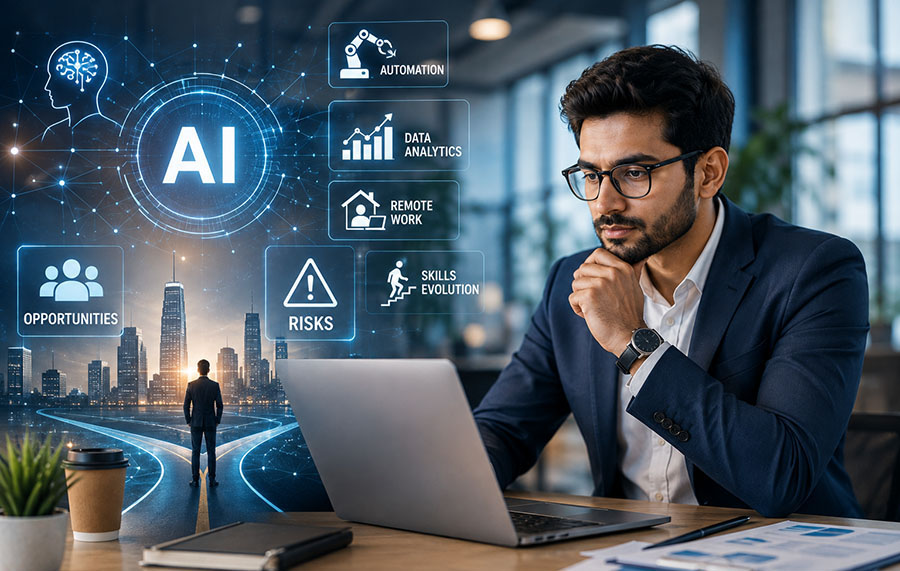
AI and the Future of Work: Opportunities, Risks & Career Skills
Artificial Intelligence is no longer just a futuristic concept—it is already changing the way people work, communicate, create, and make decisions. From automated customer support and AI-powered marketing to data analysis and software development, businesses across industries are using AI to improve productivity and efficiency.
But one important question remains: Is AI creating new opportunities for professionals, or putting jobs at risk?
The answer is not simply one or the other. AI is likely to eliminate or transform some tasks while creating new roles, skills, and career opportunities. For professionals, the biggest advantage may come from learning how to work with AI rather than compete against it.
“The advance of technology is based on making it fit in so that you don't really even notice it.” — Bill Gates
How AI Is Changing the Workplace
AI can handle many repetitive and time-consuming tasks that previously required significant human effort. It can analyze large amounts of data, generate content, summarize information, identify patterns, automate workflows, and assist with decision-making.
This allows professionals to spend more time on activities that require creativity, communication, critical thinking, leadership, and human judgment
For example, a marketing professional can use AI to analyze customer behavior and generate campaign ideas, while the human team focuses on strategy, brand positioning, and understanding the audience.
AI Creates New Career Opportunities
While automation may reduce demand for certain repetitive tasks, AI is also creating completely new areas of work.
Growing opportunities include:
- AI and machine learning
- Data analysis and data science
- AI product management
- Automation and workflow design
- Cybersecurity
- AI governance and ethics
- Digital marketing and AI-powered content
- Prompt and AI workflow development
- Technology consulting
Will AI Replace Human Jobs?
AI may replace some tasks, but replacing an entire profession is more complicated.
Jobs involving repetitive, predictable, and highly standardized tasks may face greater automation pressure. However, careers that depend heavily on empathy, leadership, creativity, negotiation, complex decision-making, and personal relationships are harder to automate completely.
The workplace of the future may therefore involve a shift from “AI versus humans” to “AI plus humans.”
Professionals who learn to use AI tools effectively can potentially become more productive and valuable within their organizations.
The Skills Professionals Need for the AI Era
Technical knowledge is useful, but professionals don't necessarily need to become AI engineers. Some of the most valuable skills for the future include:
1. AI Literacy
Understand what AI can do, where it performs well, and where human oversight is necessary.2. Critical Thinking
AI can produce incorrect or misleading information. Professionals need to evaluate results rather than accept every AI-generated answer.3. Communication
Clear communication remains essential for teamwork, leadership, customer relationships, and effective AI interaction.4. Creativity
AI can generate ideas, but human creativity, context, experience, and originality remain important.5. Adaptability
Technology will continue to change. Professionals who are comfortable learning new tools and updating their skills will be better prepared for change.AI and Productivity: A Major Opportunity
One of the biggest benefits of AI is increased productivity.Imagine spending hours preparing reports, analyzing spreadsheets, organizing information, or creating first drafts. AI can assist with many of these tasks, allowing professionals to focus their time on higher-value work.
However, productivity gains depend on how AI is used. Businesses need appropriate policies, data protection, quality checks, and human oversight to ensure that speed does not come at the expense of accuracy or trust.
The Risks Professionals Should Consider
AI also brings genuine challenges.Some concerns include:
- Job displacement in highly automatable roles
- Privacy and data-security risks
- AI-generated misinformation
- Bias in automated decisions
- Overdependence on technology
- Skill gaps between workers
- Lack of transparency in some AI systems
How Professionals Can Prepare for the Future
The best time to start learning about AI is now. You don't need to master every new tool. Instead, identify where AI can make your current work faster, better, or more efficient.Start by:
- Learning the basics of generative AI.
- Experimenting with AI tools relevant to your profession.
- Automating repetitive tasks where appropriate.
- Improving your data and digital skills.
- Staying updated with industry trends.
- Strengthening human skills such as leadership and communication.
- Checking AI-generated information before using it professionally.
Final Thoughts
AI is transforming the world of work, but the future doesn't have to be viewed through a lens of fear. Every major technological shift has changed the nature of work, and AI is likely to do the same.Professionals who resist change may find the transition difficult, while those who learn, adapt, and use AI responsibly can turn technological change into an opportunity.
The future of work may not belong to people who know the most about AI—it may belong to people who know how to use AI effectively while bringing uniquely human skills to the table.