Career After 10th Class: Best Courses, Streams and Future Opportunities
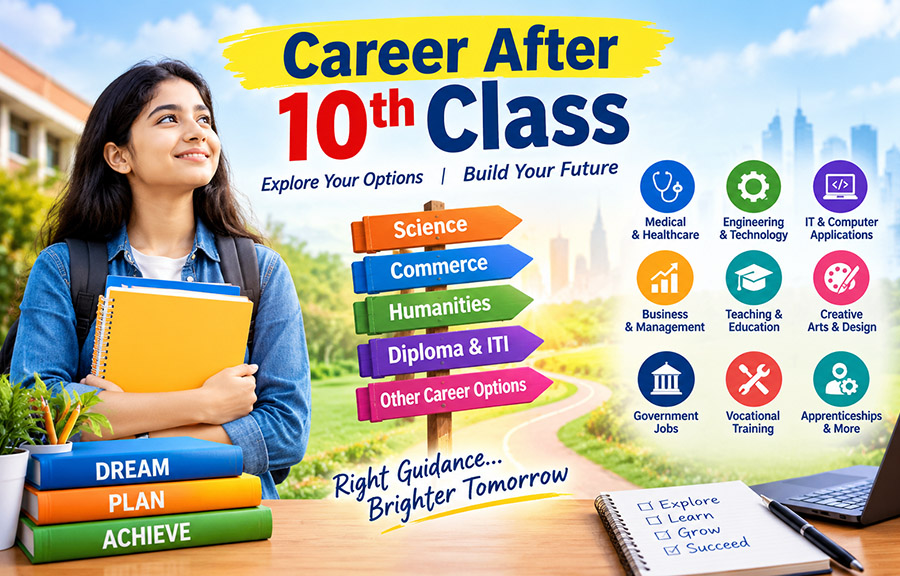
Completed Class 10 and wondering what to do next? You have several routes to explore. You can continue with Science, Commerce or Humanities in Class 11, choose a polytechnic diploma, learn a trade through an ITI, or consider a recognised vocational course. The right option depends on what you enjoy, how you learn, your budget and the kind of future you want to build.
There is no single “best career after 10th class” for every student. A thoughtful decision is better than choosing a stream only because friends are choosing it or because someone says it guarantees a high salary. This guide explains the main courses after 10th in India, how to compare them and what to check before applying.
Why Is Choosing a Career After Class 10 Important?
Class 10 is an important milestone because it often determines your next subjects or training route. But it does not lock you into one career for life. Many people build their careers through further study, practical experience, professional training and continuous learning. The goal now is to choose a suitable next step and keep future pathways open where possible.
Before deciding, think about the subjects you enjoy, the tasks you like doing, your strengths, the qualifications required for your future interests and the total cost of study. Speak with a teacher, parent or qualified career counsellor if you are unsure.
Best Career Options After 10th Class in India
1. Science Stream: For Students Interested in Science and Technology
Science may suit students who enjoy mathematics, experiments, biology, technology or understanding how things work. Depending on your subject combination and later qualifications, possible directions include engineering, medicine and allied health, pharmacy, computer science, research, laboratory sciences and environmental studies.
- PCM (Physics, Chemistry and Mathematics): often considered for engineering, computing and technical fields.
- PCB (Physics, Chemistry and Biology): may support later study in medical and allied health fields, life sciences and biotechnology.
- Other combinations: some schools offer PCMB or alternative subject combinations. Check the school’s options and the workload carefully.
Choose Science because you are interested in its subjects and ready for regular practice—not only because you have heard it offers “more scope.” Admission requirements for future courses can change, so verify them with the relevant institution or examination authority.
2. Commerce Stream: For Business, Finance and Management
Commerce can be a good fit if you are curious about business, accounting, money, markets, economics or how organisations work. With further education and relevant qualifications, possible career directions include accounting, finance, banking, business management, taxation, marketing, economics and entrepreneurship.
Subject combinations differ by school. If you have a particular degree or professional qualification in mind, check whether mathematics or another subject is required for entry.
3. Humanities or Arts Stream: For Society, Languages and Creative Thinking
Humanities may appeal to students interested in history, politics, geography, languages, psychology, culture, writing or social issues. Future directions can include law-related study, journalism, teaching, public administration, social work, media, design, research and language-based careers, depending on the qualifications needed.
Arts is not a lesser stream. Communication, research, critical thinking, creativity and understanding people are valuable skills across many professions.
4. Polytechnic Diploma Courses After 10th
Polytechnic diplomas offer a technical and applied learning route for eligible students after Class 10. Depending on the institute and state, programmes may include:
- Mechanical Engineering
- Civil Engineering
- Electrical Engineering
- Electronics and Communication
- Computer Science or Information Technology
- Automobile Engineering and other applied technical areas
Course duration, entrance tests, eligibility, fees and admission schedules vary. Some diploma holders may later qualify for lateral entry into a related degree programme, subject to current rules. Check recognition, lab facilities, practical training and progression options before enrolling.
5. ITI Courses After 10th: Build Practical Trade Skills
Industrial Training Institutes (ITIs) provide trade-focused training for students who prefer hands-on learning. Depending on eligibility and local availability, examples include Electrician, Fitter, Welder, Mechanic, COPA (Computer Operator and Programming Assistant), Refrigeration and Air Conditioning, Sewing Technology and other trades.
Training may support applications for trade-related work, apprenticeships or further skill development. Compare the exact trade, affiliation, workshop facilities, safety practices, fees and practical hours. Government and private institutes can differ, so verify the individual institute and course rather than relying only on its name.
6. Vocational and Skill-Based Courses
Vocational courses can help you develop focused skills in areas such as computers, office tools, graphic design, video editing, hospitality, retail, beauty and wellness, automotive service, electronics repair, agriculture or food production. Some programmes are short certificates, while others take longer and have specific entry requirements.
Look for practical assignments, experienced trainers, a clear syllabus and a recognised awarding body where recognition is important for your goal. A certificate alone does not guarantee employment; useful skills, practice and work experience matter.
7. Computer and Digital Skills
If you enjoy working with computers, you can explore computer fundamentals, office productivity tools, basic coding, web design, computer hardware, networking or digital content skills. Choose a course that gives you hands-on practice and projects you can demonstrate. Be cautious of programmes that promise a guaranteed high salary after only a few weeks of training.
8. Creative and Service-Oriented Courses
Students interested in creative or people-focused work may explore photography, design fundamentals, tailoring, food production, hospitality, customer service or other locally available vocational options. Check course quality, equipment, supervised practice, costs and realistic entry-level opportunities before making a commitment.
Career Options After 10th: Quick Comparison
| Option | May suit you if you enjoy | Possible next step |
|---|---|---|
| Science | Science, maths, health or technology | Related degree, professional course or technical pathway |
| Commerce | Business, accounting, finance or economics | Commerce degree, finance, accounting or management pathway |
| Humanities / Arts | Society, history, languages, writing or creative subjects | Humanities degree, media, education, law-related or other study |
| Polytechnic diploma | Applied technical learning and problem-solving | Technical work, further diploma study or eligible degree entry |
| ITI trade | Tools, machines, repairs or practical work | Trade-related work, apprenticeship or further training |
| Vocational course | Learning a specific job-related skill | Entry-level work, additional training or suitable self-employment |
This comparison is a starting point, not a promise of admission or employment. Outcomes depend on the course, training quality, eligibility, local opportunities and your skills.
How to Choose the Right Course After 10th
- List your interests. Write down the subjects and activities you enjoy. Consider whether you prefer solving problems, working with people, creating things, studying theory or using tools.
- Understand your strengths. Marks can help you reflect, but they are not the only measure of potential. Consider curiosity, consistency, practical ability and willingness to practise.
- Research the actual work. Find out what people in your shortlisted careers do each day and which qualifications employers or professional bodies require.
- Compare the total cost. Include tuition, exam fees, books, equipment, transport, accommodation and other charges. Ask about scholarships or financial support if relevant.
- Verify eligibility and recognition. Check the latest official prospectus, course requirements, institute affiliation and future-study options.
- Talk to trusted people. Discuss your shortlist with a teacher, guardian, counsellor or someone with first-hand experience in that field.
- Keep a backup option. Select one or two realistic alternatives that still match your interests and longer-term goals.
Can You Get a Government Job After 10th?
Some government recruitment notifications accept Class 10 as the minimum educational qualification, but requirements vary by post. Age limits, physical standards, skill tests, medical requirements and other conditions may apply. Many other government roles require additional education or specific examinations.
To find genuine vacancies, start with the official website of the recruiting department and read the latest notification. Confirm the qualification, age criteria, dates, syllabus and application process before applying. Avoid agents or websites promising guaranteed selection in exchange for money.
Even if you plan to work soon, continuing education or building a recognised technical skill can widen your options. Strengthen basic mathematics, language, reasoning, digital literacy and communication skills alongside your chosen route.
Documents and Checks Before Admission
- Read the current admission notice or prospectus.
- Confirm the course name, duration, entry qualification and age requirements.
- Check who awards the certificate, diploma or trade qualification.
- Ask for a written breakdown of fees and the refund policy.
- Inspect practical facilities and ask how much hands-on training is included.
- Check internship, apprenticeship or placement support without assuming that a job is guaranteed.
- Keep copies of application forms, receipts and official communication.
A Simple 30-Day Career Planning Plan
- Days 1–7: List your interests, strengths and three career areas you want to explore.
- Days 8–14: Compare school streams, diploma programmes, ITI trades and vocational courses. Note eligibility and likely costs.
- Days 15–21: Talk with a teacher or counsellor, discuss your shortlist with your family and contact institutions for accurate details.
- Days 22–30: Verify admission deadlines through official sources, choose your preferred route and prepare the required documents.
Adjust this plan to the actual admission calendar. Do not rely on outdated social media posts for deadlines or eligibility information.
Common Mistakes to Avoid After Class 10
- Choosing a stream only because friends or relatives recommend it.
- Believing one stream automatically guarantees a high salary or a successful career.
- Joining an institute without checking recognition, practical facilities and total fees.
- Trusting claims of guaranteed jobs or government selection.
- Ignoring communication, digital literacy and real practice.
- Assuming that vocational or technical training is less valuable than an academic route.
Frequently Asked Questions About Career After 10th
Which is the best course after 10th class?
There is no single best course for everyone. Science, Commerce, Humanities, polytechnic diplomas, ITI trades and vocational courses can all be suitable depending on your interests, abilities, budget and goals.
Can I do a diploma after Class 10?
Yes. Many polytechnic programmes accept students after Class 10, subject to the course and institution’s current eligibility and admission rules.
Are ITI courses a good option after 10th?
They can suit students who prefer practical trade training. Check the trade’s recognition, workshop facilities, fees, safety training and apprenticeship opportunities before enrolling.
Can I get a job immediately after 10th?
Some entry-level roles may accept Class 10, but requirements vary. Further education or recognised skill training may broaden your opportunities. Be cautious of offers that ask for money in exchange for a guaranteed job.
What if I am confused about my career?
Shortlist two or three options, compare subjects and everyday work, and speak to a trusted teacher or qualified career counsellor. You do not have to plan your entire life today; focus on making a well-informed next decision.
Final Thoughts: Build Your Future One Step at a Time
Choosing a career after 10th class is an important decision, but it does not need to feel overwhelming. Understand your interests, compare realistic options and verify course details before committing. Whether you choose Science, Commerce, Humanities, a diploma, ITI or vocational training, keep building knowledge, confidence, communication and practical skills.
Your first choice does not define your whole life. A thoughtful next step, consistent effort and a willingness to keep learning can help you move towards a career that is both meaningful and achievable.